 Thailand
 Malaysia
 Singapore
 Indonesia
 Philippines
 Australia
 United
States
United
States United Kingdom
 India
India









































































 Thailand
 Singapore
 Indonesia
 Australia
 United States
 United Kingdom
Adjustable vs Fixed: Which Ergonomic Table Actually Improves Posture?

When people think about improving posture, they usually start with the chair. But posture doesn’t begin at the backrest—it begins at the ergonomic table you use every day.
If your table is too high, your shoulders lift slightly without you noticing. Too low, and you hunch forward. Over time, these small misalignments turn into rounded shoulders, forward head posture, and lower-back compression. The discomfort often builds slowly. A tight neck here, a sore shoulder there. Because it develops gradually, many people assume it’s just “normal” after a long workday.
The truth is, poor desk ergonomics quietly shapes your posture hour after hour.
This raises an important question: does an adjustable ergonomic table actually improve posture more effectively than a fixed one? The answer lies in how each design interacts with your body over time.
Ergonomics Beyond the Chair
Even the most advanced ergonomic chair cannot fully compensate for a poorly designed table. If your elbows sit too high or your monitor is too low, your spine adjusts to match the table—not the chair.
Table height determines:
-
Elbow angle while typing
-
Wrist alignment on the keyboard
-
Shoulder tension
-
Neck positioning relative to the monitor
Without proper height alignment, posture correction becomes almost impossible. That’s why choosing between a fixed and adjustable ergonomic table isn’t just about convenience—it’s about spinal health.
Understanding Fixed Ergonomic Tables
How Fixed Tables Are Designed
Fixed ergonomic tables are built at a single, non-adjustable height. Typically, they are designed around “average” body proportions—usually assuming a user of medium height seated in a standard chair.
The appeal is simplicity. No motors. No mechanical systems. Just a stable surface that doesn’t move.
Many traditional office desks fall into this category. They aim to provide general usability across different users, especially in shared office environments.
Posture Benefits and Limitations
A fixed ergonomic table can support good posture—if it perfectly matches your body dimensions.
When properly matched:
-
Elbows rest at roughly 90 degrees
-
Wrists remain neutral
-
Monitor aligns with eye level (with proper stand adjustments)
However, real life isn’t static. You might:
-
Change chairs
-
Wear shoes with thicker soles
-
Switch between typing and drawing
-
Share the table with another person
-
Work longer hours than expected
In these situations, a fixed-height table can quickly become limiting. Even a difference of 2–3 centimeters can cause shoulder tension or wrist extension over time.
Posture isn’t just about finding one “correct” position. It’s about supporting the body throughout varied daily movements.
Understanding Adjustable Ergonomic Tables
The Mechanics of Adjustability
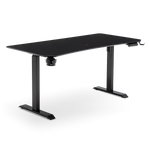
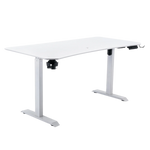
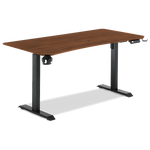
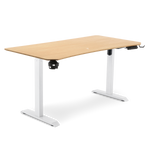
An adjustable ergonomic table is designed to move with you. Whether manual or powered, it allows precise height customization.
Manual versions use a crank system, while an electric standing desk adjusts smoothly at the press of a button. This precision makes it easier to fine-tune alignment rather than settling for “close enough.”
With proper adjustment:
-
Forearms remain parallel to the floor
-
Shoulders stay relaxed
-
Wrists align naturally with the keyboard
-
Monitor height matches eye level
The ability to make micro-adjustments is what separates an adjustable standing desk from a fixed one.
For those researching what is a standing desk, it’s essentially a height-flexible workstation designed to support both sitting and standing positions while maintaining ergonomic alignment.
Supporting Dynamic Posture
The real strength of an ergonomic standing desk lies in promoting dynamic posture. Instead of locking your body into one position, it encourages movement.
Alternating between sitting and standing:
-
Reduces spinal compression
-
Improves circulation
-
Engages core muscles gently
-
Prevents stiffness
Spinal health depends on movement. Static posture—even “perfect” posture—can lead to fatigue if maintained for hours.
An adjustable table transforms posture from a fixed state into an active process.
Adjustable vs Fixed: A Direct Posture Comparison

Spinal Alignment and Neck Position
With a fixed ergonomic table, spinal alignment depends heavily on whether the height matches your body proportions. If it doesn’t, you may lean forward to reach the keyboard or tilt your head downward to see the screen.
Over time, this forward head position increases strain on the upper spine and neck muscles.
An adjustable standing table desk allows you to align the surface precisely with your seated or standing elbow height. This reduces the need to compensate with your neck or shoulders.
The result:
-
More neutral spine
-
Less upper-back tension
-
Reduced long-term neck strain
Even small adjustments can make a noticeable difference over months and years of daily use.
Shoulder, Arm, and Wrist Ergonomics
Shoulder tension often starts with table height. If the surface is too high, shoulders elevate subtly. If too low, you collapse inward.
Wrist position is equally sensitive. A slight upward angle during typing increases strain on tendons, potentially leading to repetitive stress discomfort.
An adjustable standing desk lets you refine the height to maintain:
-
Neutral wrists
-
Relaxed shoulders
-
Balanced forearm support
Fixed office desks, on the other hand, require your body to adapt to a single height—regardless of task variation.
Which Ergonomic Table Improves Posture the Most?
Individual Body Types and Work Habits
There is no universal “perfect” height. Factors such as:
-
Overall height
-
Arm length
-
Torso length
-
Type of work performed
-
Daily working hours
All influence what setup works best.
For someone who works 8–10 hours at a computer, posture needs will change throughout the day. An adjustable table adapts to those changes.
This flexibility is one reason adjustable models are becoming increasingly popular in the standing desk Thailand market, where remote work and hybrid setups are now common.
When comparing fixed versus adjustable, the latter generally offers better long-term posture support because it accounts for real-world variability.
Use Cases: Office, Home, and Gaming
Different environments place different demands on posture.
-
Office Work
Long typing sessions benefit from precise elbow and wrist alignment. Adjustable models allow quick fine-tuning throughout the day. -
Home Workspaces
Shared desks or multipurpose rooms require flexibility. A single height rarely fits every user. -
Gaming Setups
Gaming involves intense focus and extended sessions. An adjustable setup allows posture changes without interrupting play.
Brands like TTRacing offer a range of adjustable solutions designed for both productivity and gaming environments.
For users searching for the best standing desk, prioritizing smooth adjustment, stability, and a wide height range is essential.
Conclusion: Making the Right Ergonomic Choice

Posture-Focused Takeaways
When comparing adjustable versus fixed designs, one conclusion becomes clear: posture thrives on adaptability.
A fixed ergonomic table can work well if perfectly matched to your body and tasks. However, most real-world work scenarios involve variation—different chairs, different activities, different energy levels.
An adjustable standing desk supports:
-
Precise height alignment
-
Natural wrist and elbow positioning
-
Reduced shoulder tension
-
Dynamic posture throughout the day
Because posture isn’t static, your table shouldn’t be either.
If you’ve been experiencing neck stiffness, shoulder tension, or lower-back fatigue, it may be time to look beyond your chair and examine your desk.
An adjustable or electric ergonomic table offers more than convenience—it provides the flexibility your spine needs for long-term comfort.
Take a moment to evaluate your current setup. Your posture reflects the environment you create. Upgrading to a smarter, height-adjustable standing desk could be one of the most practical investments you make in your daily health and productivity.
Contact us for more details or to view various models on our website: https://TTRacing.co.th/ or chat with us via Line @TTRacing or Facebook: TTRacing Thailand. We are happy to provide consultation and service to you.
Follow news and great promotions from TTRacing Thailand at
Facebook: TTRacing Thailand
TikTok: TTRacing_Thailand (Live channel)
Instagram TTRacing_th
X: TTRacing
YouTube: TTRacing
Frequently Asked Questions (FAQ)
1. Does an adjustable desk really improve posture?
Yes. An adjustable desk allows you to set the height precisely to match your body, keeping your elbows at 90 degrees, shoulders relaxed, wrists neutral, and monitor at eye level. This helps prevent neck and shoulder strain over time.
2. Is a fixed desk bad for posture?
Not necessarily. A fixed desk can support good posture if its height perfectly matches your body. However, even small height mismatches can gradually lead to discomfort in the neck, shoulders, or wrists.
3. Can switching between sitting and standing reduce back pain?
Yes. Alternating between sitting and standing reduces spinal compression, improves circulation, and prevents muscle stiffness caused by prolonged sitting.
4. How do I know if my desk height is correct?
Your desk height is likely correct if:
-
Your elbows form a 90-degree angle
-
Your shoulders feel relaxed
-
Your wrists remain straight while typing
-
The top of your monitor is at eye level
5. Which is better: adjustable or fixed desk?
If you work long hours or want flexibility throughout the day, an adjustable desk generally provides better long-term posture support. A fixed desk works well only if it matches your body dimensions accurately.